Book Review | Sarinka: A Sephardic Holocost Journey

Sarinka has been sitting on my shelf, waiting to be read, for almost a year. When I packed the book to read on vacation, I didn’t know a surprise attack would kill hundreds and launch Israel into war. Tucked away in the woods of Maine with my phone off, I read a story that is decades old and yet tragically relevant for today.

Image shows a bookcover that reads, "Sarinka: A Sephardic Holocost Journey from Yugoslavia to an Internment Camp in America." The cover image shows a black and white image of a Jewish girl in Turkish Muslim attire superimposed on a color image of a Yugoslavian town with ancient ramparts and mountains.

“No one will come [to our wedding]. The Germans invaded Yugoslavia this morning. I heard it on the radio. It’s too dangerous for anyone to come. We must go to the rabbi and see if he will marry us immediately.”

Simply told but still powerful, this is a daughter’s tribute to her parents–their story told in their own words.

Sarinka and Leon, Sephardic Jews from Yugoslavia, were married on the day Germany invaded their country. Their first years of marriage were spent fleeing for their lives and saying farewell to family members they would never see again. They became one of the 1,000 refugees brought to Oswego, NY … the only European refugee group allowed into the United States during the war.

This is their story.


A picture of a museum plaque that reads, "I made a life-long friend just because I took a walk along the fence to see the residents. I twas one of the best walks I ever took."

I was in high school when I first learned about Oswego, NY and its signifance during WWII. I was doing research for a post WWII story idea, flipping through old newspapers on the library’s microfiche, when I came across an article about a group of refugees accepted into the United States by special executive order. After more research, I was astounded to learn this was the only refugee group accepted into the country during the entirity of the war.

Leah, the blog author, a 20-something blond woman wearing a pink hair scarf smiles in front of a museum sign reading "Safe Haven"

From that point on, the Safe Haven museum (newly established when I first learned of it) became a buck list destination for me. I finally got to visit last fall and, based on the amused reaction of the curator when she checked me out, was one of their biggest spenders when it came to buying books. Sarinka was one of those books.

The phrase “never forget” is inextricably linked to the Holocost. The triumph of the refugees who came to Oswego and the tragedy that there were not more links that phrase more closely to American history and experience.

Perhaps now, more than ever, may we remember to embrace the words engraved on one of our country’s most famous landmarks. The words many of our own ancestors traveled past as they came in search of new opportunities.

Give me your tired, your poor, your huddled masses yearning to breathe free, the wretched refuse of your teeming shore. Send these, the homeless, tempest-tossed to me, I lift my lamp beside the golden door!


Content

Recommended for adult and teen readers. Younger readers may benefit with parental involvement.

Romance: Minimal. Sarinka and Leon’s affection is apparent in their devotion and trust for one another. The description of their physical expression of that love is only depicted in a few kisses.

Violence: The barbaric expression of antisemitism is explained as simply as possible and yet remains grusome. Includes mention of toddlers being killed to desensitize soldiers and sexual abuses against women.

Language: I don’t recall any profanity. Minimal if any.

Religion: Leon and Sarinka practice Judaism and have respectful friendships with Protestant and Muslim neighbors.

Keep Reading

Book Review: Salt to the Sea

Deadliest maritime disaster in recorded history. Any guesses? The first to come to most minds would probably be the Titanic. My second guess would be the Lusitania, an ocean liner sunk during WWI. Neither maritime disasters were the deadliest in recorded history. When a German u-boat torpedoed the Lusitania, 1,198 passengers perished. After the “unsinkable” Titanic struck an iceberg, approximately 1,500 passengers died. The well-known and often spoken of Titanic disaster is dwarfed by an unheard of tragedy during WWII–the sinking of the Wilhelm Gustlov.

Published in February of 2016, the novel Salt to the Sea is dedicated to telling the story of the Wilhelm Gustlov, a German ocean liner that took approximately 9,000 lives with it when it was sunk during WWII.

Salt to the Sea

Continue reading “Book Review: Salt to the Sea”

Book Review: Maggie Bright

Do you know the story of the Miracle of Dunkirk? I first heard of it when researching for a post-WWII novel I wrote for a competition. Soundly routed by the German army, the British Expeditionary Force was pushed out of Belgium and Northern France. The ended up pinned down on the Beach of Dunkirk. Only the English Channel separated them from home but it seemed an insurmountable barrier. The effort to get the soldiers back to British soil is known known as the largest evacuation in military history, and it was largely made possible by the mobilization of civilian boats, many of them manned by their civilian owners.

Maggie Bright

Continue reading “Book Review: Maggie Bright”

Book Review & Giveaway: Burying the Sun & Angel on the Square

Burying the Sun *Giveaway Closed*
It’s been a while since I did a giveaway, but this month’s giveaway item is a copy of Angel on the Square, book one in Gloria Whelan’s St. Petersburg series. The giveaway is open only to readers in the US. To enter, leave a comment telling us about your favorite WWII book.

All that was long ago, and until that morning I had thought I would have no chance for my own adventures, only day after day of dreary study and work. With talk of war with Germany, the world was suddenly more exciting.

To fourteen year old Georgi, the idea of war with Germany seems exciting. Though too young to join the army and unable to find a way to sneak in anyway, Georgi throws himself into volunteer work, determined to help protect his country. It isn’t until the Germans begin surrounding Leningrad that reality sinks in. Now Georgi concerns himself with protecting his shrinking circle of family and friends. Can Georgi succeed in bringing himself and those he cares about through a brutal winter as he grows into manhood?

I enjoyed re-reading this book in preparation to write this review (I’m actually not quite finished yet). It’s been several years since I read it, and this time through I’ve been really appreciating the amount of research woven into the story. Gloria Whelan draws you into the lives of the people trapped inside Leningrad during the winter of 1941. A unique angle on the events of WWII.

Author: Gloria Whelan
Audience: Middle Grade–Tween
Genre: Historical Fiction
Pages: 205

Don’t forget to comment for your chance to win Angel on the Square! The winner will be announced next Thursday

Book Review: Number the Stars

Number the Stars

Then he continued. “I’m sending Inge to you today with the children, and she will be bringing you a carton of cigarettes.”

At her grandparents home in Denmark, Annemarie Johansen can look across the water and see Sweden. When the Nazi’s begin deporting Jews, Annemarie’s best friend, Ellen, comes to live with them. But even masquerading as one of the Johansen’s daughters, Ellen is not safe. After Nazi’s invade their home and question Ellen’s parentage, Annemarie’s parents make plans to visit her Uncle Henrik, who fishes the water between Denmark and Sweden. Her father promises to send Uncle Henrik a carton of cigarettes, and Annemarie realizes they’re talking in code. Cartons of cigarettes are Jews, and they’re talking about Ellen.

I can’t remember if we did this book as a family read-a-loud or listened to it on a road trip, but either way, Number the Stars is the first book I remember “reading” about Jews during WWII. While Lois Lowry is probably best known for her dystopian novel, The Giver, Number the Stars still takes first place for me. It’s another great book for learning about about or supplementing a class on WWII. Or just to read for fun. ๐Ÿ™‚

Author: Lowis Lowry
Audience: Middle Grade–Tweens
Genre: Historical Fiction
Pages: 137

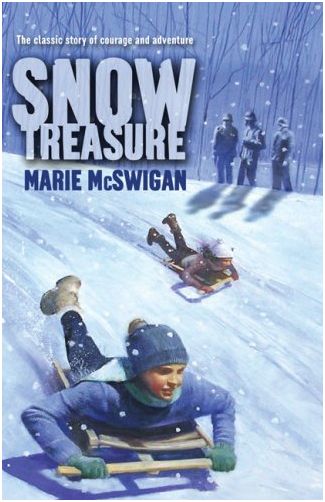
Book Review: Snow Treasure

Snow Treasure

“Look!” Michael could not take his eyes off the beach. “Soldiers marching right up our sled track. How’ll we get down?”

In the winter of 1940, Peter Lundstrom and the other members of his Norwegian village watch helplessly as German soldiers invade their homeland. While there is little they can do about the Nazi’s presence, they determine not to surrender everything quite so easily. Instead of waiting for the invaders to steal their large store of gold, they come up with a dangerous plan to sneak it out of the country. A plan that depends on the courage of young Peter and his friends. The school children of the village begin transporting the gold bullion right past the Germans and hiding it for the adults to move onto Uncle Victor’s boat. Can the children succeed in outwitting the Germans and saving the gold?

This story is one of the first books I distinctly remember listening to during one of our road trips. Since that time we’ve listened to it again, and I’ve read the book once or twice on my own. Snow Treasure is believed to be based on a true story, though the tale has never been proven. Whether true or not, the courage and adventures of Peter Lundstrom and his friends are well worth reading. A wonderful living book to add to your library.

Author: Marie McSwigan
Audience: Middle Grade–Tween
Genre: Historical Fiction
Pages: 156

Youth, Homeschooling, the Past and the Future

Romeike

He alone, who owns the youth, gains the future.

Do you know who said this? Keep reading and I’ll tell you.

A few days ago I made a post titled Support the Romeikes. The Romeike’s are a German family who came to the states to escape persecution in their homeland. Several of you clicked through to the petition started on their behalf. Thank you. Today HSLDA (Homeschool Legal Defense Association) published a video about the Romeikes. I’m embedding it here if you want to watch it.

As soon as Mr. Romeike said, “The government wants the right to impose what they think children should learn.” I knew I’d heard that sentiment before. You read it in the quote posted above. Those words were spoken by a government leader in Germany. Have you guessed who? It was Adolf Hitler.

That’s right. A lot of people don’t know that governmental control of the German youth was a huge part of Hitler’s devastating plan for the Third Reich. And now the German people are fighting this war again. What’s even scarier is that we here in the United States need to fight it too because our government wants the same power. And Hitler was right, whoever controls the education of the children controls the future of the country.

To quote Hitler again:

How fortunate for governments that the people they administer don’t think.

We need to think. English statesman Edmund Burke once said, “The only thing necessary for the triumph of evil is for good men to do nothing.” He also stated that, “Those who don’t know history are doomed to repeat it.” He was right. On both counts.

Whether or not you support homeschooling, it’s important to recognize that absolute control over education should not be handed over to any government. It led to disaster in Germany and it can easily do the same again. Except this time it could be the downfall of our “bastion of freedom,” the US. Let’s not make the same mistake made by so many people before and during WWII. The mistake of silence. To close, consider this quote from another English statesman, William Wilberforce.

You may chose to look the other way but you can never again say that you did not know.

Book Review: My Brother, My Sister, and I

“Is Honorable Sister going to die?” I asked. I could not stop the tears.

With her mother dead and her father missing, thirteen year old Yoko, older sister Ko, and her older brother Hideyo struggle to survive. When Ko is seriously injured in a fire, Hideyo searches for more work to pay hospital bills and Yoko takes on the responsibility of caring for Ko. When Ko is accused of murdering their landlords, Yoko is determined to prove her sister’s innocence.

This is a great story about a Japanese girl in the aftermath of World War II. It is based on a true story. I recommend this book as a gripping and educational read.

Author: Yoko Kawashima Watkins
Audience: 12 and up
Genre: Historical Fiction
Pages: 224
Publisher: Simon Pulse

Read More Book Reviews