
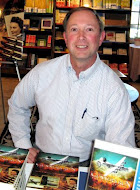
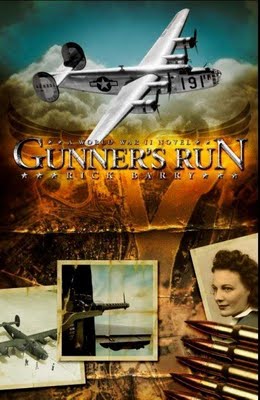
I am so excited that Rick Barry, author of Gunner’s Run, (click here for my book review of Gunner’s Run) is here to answer a few questions about Gunner’s Run and writing. If you haven’t already read Gunner’s Run, I encourage you to think about doing so. Enjoy the interview!
What was the most unexpected fact or story you uncovered while researching for “Gunner’s Run”?
Looking back, I believe the most unexpected fact I discovered in my research concerned traitors who aided the Nazis voluntarily, particularly in Belgium. I had been to Belgium before, but obviously not during World War II. So I had never realized how some Belgians quickly tried to get in good with the victorious Nazi invaders by helping them and spying for them and turning in citizens who secretly resisted the invasion. This is the fact that led me to create the character Henri, who at first befriends Jim Yoder, but later imprisons him in order to turn him over to the Nazi regime for a reward.
What message would you like readers to take away from “Gunner’s Run”?
I will word this answer carefully, because I don’t want to spoil the story for anyone who hasn’t read the book yet. However, you can say that Jim Yoder never viewed himself as a hero and at the beginning of the story really had no interest in God whatsoever. He thought he was in pretty good control of his life. But when reality strikes and he finds himself alone, away from all his friends, and on the run behind German lines, he realizes he really is not the captain of his own fate, that he could be shot and killed any moment. That’s when he begins recalling everything that he ever learned about God and begins to trust in Him instead of himself.
What advice would you give to a person trying to become a fiction writer?
This is a terrific question, but it’s also one that could fill up a whole book by itself. Today’s fiction writers face a lot of competition, so in order to rise above the mass of mediocre writing being done out there, I would give several starter tips:
1. Read–a lot! And I don’t mean short, frivolous stuff. Especially read books in the genre you want to write someday, and you’ll be filling your brain with good plots, good background information, good examples of grammar, etc. Even without taking a course in writing, people who read widely greatly expand their literary and historical horizons. At the same time, though, be discerning in what you read. Many novelists fill their stories with illicit relationships, vulgar language, and other unseemly details not fitting for the brain of a wholesome person. If you feed your brain unclean images and stories, you can pollute your thinking. I’m a Christian writer, and I don’t want to feed on literature that describes intricate details of things that God despises.
2. Pay attention to good English. Learn the right way to punctuate. Study how quality writers use punctuation marks. Master proper spelling. If you depend on your computer’s spell-checker to get the spelling and punctuation correct, then you are headed for trouble. Very often your computer will not understand what you’re trying to spell when you write plain or plane, affect or effect, insure or ensure, etc. Words and punctuation form the writer’s toolbox. Master the use of your tools just as a carpenter masters his tools, and just as the surgeon learns how to use his surgical instruments.
3. Develop a thick skin. Most writers will sooner or later ask someone else to read their manuscript and provide feedback. However, many, many of these people don’t really want honest feedback. Instead they want praise, and they will bristle when others point out errors or weaknesses. If you want to improve, take criticism in stride. If someone points out a problem, don’t get defensive or angry. Instead, objectively consider the statement and see how you can make your work better. Also, if someone praises your work, that’s nice, but it’s not helpful. Thank them for the compliment but still press them and say, “But how can I make it better?”
4. Subscribe to magazines specifically for writers. Good examples are The Writer, Writer’s Digest, and Christian Communicator.
5. You can learns tons of information about the publishing world today by reading the blogs of well-known Christian literary agents. I particularly recommend the blogs of the Steve Laube Literary Agency (http://stevelaube.com/blog/) and the blog of the Books & Such Agency (http://www.booksandsuch.biz/blog/). These agencies provide truly valuable information and professional insight on their blogs, and it’s free! (You can even comment or ask questions, and the agents will answer your questions, so these are terrific learning tools.)
Is there anything else you would like to share with readers?
Technology is changing, and the whole world is changing, but people still love a good story. The power of story is tremendous regardless of whether it comes as a book, or on a Nook, or on some other device. The author who can weave a good story can lead the brains of readers to places and times they’ve never personally experienced. If the story causes that reader to become a better person as a result of your words, then that is truly rewarding.
You can visit Mr. Barry at his own blog by clicking here.

 Leah E. Good