
 It seems that this is the week for guest posts! Marli Renee, who blogs at cuppaweek.wordpress.com, found me through the CollegePlus! student forum and asked me to do a guest book review. I was thrilled (and said yes, of course ;)). Click on the picture to read my review of Crown of Fire.
Author Interview: Chuck Black
 On Monday I posted a review and giveaway of Sir Bentley and Holbrook Court. Tomorrow is the last day to enter the drawing to win a signed copy of Sir Bentley, so make sure you leave a comment on the giveaway post!
Enjoy today’s interview with author Chuck Black.
How long has it been since you started writing the Kingdom books?
I began writing the Kingdom Series books in 1999. I started with Kingdom’s Edge, the third book in the series. My inspiration for writing that first book was to find a way to help my children get excited about their faith, and to help them understand the spiritual warfare that the Bible talks about so often. The story of Jesus was the best place to start. All of the other books, including the Knights of Arrethtrae, flow out of Kingdom’s Edge.
Do you have a favorite book out of the Kingdom Series or Knights of Arrethrae Series?
That is a difficult question to answer. I like different books for different reasons. Kingdom’s Edge because it was my first and purest work. It felt as though God specifically gave it to me to write. Beyond that I don’t think I could pick one of the Kingdom Series books over the other. For the Knights of Arrethtrae series, it would probably be a toss-up between Sir Dalton and Sir Quinlan with the other four coming in a close second :).
Tell us about your journey from self-publishing to traditional publishing.
I self-published four of the Kingdom Series books because I did not want to take the long and usually unfruitful path to traditional publishing. We stumbled into a market in the homeschool community with the books that gave us an indication that there was a real need for a series of wholesome, exciting, Christian novels. After five years of watching the interest and the sales double each year, I came to a place where I was exhausted and could not keep up with the growing demand for the books. That is when I asked God to really bless the books, if it were within His will to do so. A few months later, Multnomah Publishing signed on for the books and we expanded the series from four to six books. Once those proved to be successful, I signed another contract with Multnomah for the Knights of Arrethtrae series. It has been an unusual journey all testifying to God’s hand working it all out.
What advice would you give to an aspiring writer?
I would encourage aspiring authors to read a lot and to learn the techniques of their favorite authors. For example, how does the author develop the characters, is the story plot driven or character driven, how does he handle dialog, and how much detail is necessary to make a scene feel real. I would also recommend getting the book Self-Editing for Fiction Writers by Renni Browne and Dave King. It is an excellent resource for beginning writers. Finally, I recommend practicing your writing and having people give you honest and objective feedback. Before I decided to print 500 copies of Kingdom’s Edge, I printed five copies under a pen name. I then asked people for feedback. Be prepared for both the positive and the negative feedback and then adjust. Constructive criticism is the best tool for learning, if the receiver is willing to accept it.
Do you have any new books in the works?
Actually, I just signed a contract for a trilogy with Waterbrook Multnomah. I can’t give too much a way but it will be a modern-day spiritual warfare series. I’m excited about it, and I pray that God will use it to inspire people to serve Him with all heart, soul, mind, and strength!
Is there anything else you would like to share with readers?
The central theme of all of my books is this…God is looking for hearts that are completely devoted to Him so that he might strongly support them (2 Chronicles 16:9). Find your passion for God through the talents and abilities He has given you and then say “yes” to the call and the adventure He has waiting for you. It will be the thrill of a lifetime…I guarantee it!
My website is www.KingdomSeries.com and if anyone would like to write to me, I can be reached at kingdom[at]perfect-praise.com. Thank you for the chance to share my heart with your readers.
Thank you for this wonderful interview, Mr. Black!
Author Interview: Alison Hart
Author Interview: Kristiana Gregory
Author Interview: Kimberly Brubaker Bradley
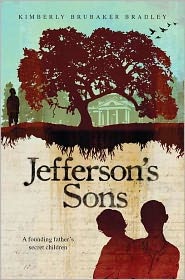 Why did you choose tell “Jefferson’s Sons” through the eyes of three characters?
This was mostly a decision based on structure. As I did the research for this book, the time frame kept expanding. I could see how the world in which Beverly spent his early years, at Monticello during the relative stillness of Jefferson’s Presidency, was very different from that in which Maddy grew up, after Jefferson’s retirement, when visitors flocked to the farm. I wanted to contrast those differences. But I also really, really, wanted to tell what I saw as the natural end of the story–that horrifying auction after Jefferson’s death–and, by that point, Beverly is long gone, and Maddy fully grown. Peter Fossett actually left a written account of his childhood at Monticello, a terrific first-person source for those final years. To start where I wanted to start, I had to be in Beverly’s voice–he’s really the only one old enough to carry the story–and at the end, I had to be in Peter’s voice, as he’s the only one left.
Theoretically I could have stayed with just those two, but there’s another problem: I wanted this book to reach middle school audiences. To do that, I have to keep a certain level of innocence in the discourse. Some of the topics we cover would be viewed and discussed very differently by adult narrators, and the minute I slide into an adult point-of-view I run the danger of losing of either being untruthful to the history, or writing something inappropriate for a fifth-grader to read. When I split the narrative three ways, so that each voice begins at around age 7 and continues into early teens (a bit younger for Peter), I could cover the ground I wanted to cover, and still write the book I wanted to write.
Please note that if this hadn’t been based so strongly on historical facts I wouldn’t have done it this way. If it were straight fiction–I was making all this up–I’d have used one narrator and a much shorter time frame. Easier on everyone. But the biggest strength of the book is that is very much based on fact.
Do you have a favorite scene in this book?
Hmm. I’d have to go with the ending–very hard to write, and it’s certainly not the happiest scene, but I was really pleased with how I got it in the end. I think it has a rhythm that suits the action.
What was one of the most unexpected facts or stories you uncovered while researching for “Jefferson’s Sons”?
There are simply tons of good stories, many of which couldn’t make it into the book. For example, Joe Fossett’s older brother Daniel, who is very briefly mentioned as having been sold away why Joe was a small boy, actually bought Wormley Hughes at the auction. He bought him for a dollar and gave him his freedom. Where Daniel had been living and how he gained his own freedom are completely unknown–from a historical point of view, he appears, then disappears again.
Part way through my research, the historians at Monticello found evidence that Patsy Fossett gained her freedom as an adult–she comes up in Census records in 1830, in Cincinnati, which is where many of the Fossetts were living, including Joe and Edith. Prior to a few years ago, she was “lost” from a historical point of view–no one knew what had happened to her.
Do you have plans for another historical fiction?
I’m in the middle of a book set in England during World War II. It features wholly fictional characters, more like my book Weaver’s Daughter than Jefferson’s Sons.
What advice would you give to a person trying to become a fiction writer?
Read everything you can. Especially read writers you admire. Write, but don’t be too eager for publication–publication is really hard, and rejection is really discouraging, and at the start you just need to write for yourself, nobody else. Forget “write what you know.” Write what you want to read.
Is there anything else you would like to share with readers?
I’m really pleased at how many people are reading and responding to Jefferson’s Sons. It’s been a really good journey. Thanks for inviting me onto your blog, and for caring about my book.
Thank you for joining us on this blog! I’m looking forward to reading your new books in the future.
Visit Kimberly Brubaker Bradley’s Website
Read More Author Interviews
Author Interview: Dandi Daley Mackall
Author Interview: Lea Wait
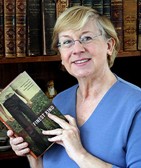 Over the years I have enjoyed all four of Lea Wait’s historical novels for young people. Last Friday I reviewed Finest Kind here on my blog. Today it is my privileged to introduce Lea for this interview.
What parts of Finest Kind are factual?
The background of FINEST KIND is accurate: because of the Panic of 1837, banks failed in Boston and other cities, there was widespread unemployment, and many families were in dire circumstances, as Jake’s family was. The acceptance (or, rather, lack of acceptance) of those born with physical or mental disabilities is accurate for that period. A little later in the nineteenth century there were institutions where families sent those with mental disabilities, but in 1837 such individuals were kept at home and hidden, or, as in Simon’s case, found a place within the community.
Wiscasset was, and is, a real town, and many of the people in FINEST KIND did live and work there. Dr. Theobold (who also appeared in my book WINTERING WELL) was the town doctor, and Thursey Seigars was his housekeeper. The minister, the shopkeepers, and other local people are real characters. Most notably, everyone who worked at (or who was incarcerated in) the Wiscasset Jail was a real person, including Samuel Holbrook, the jailer who also was a school master, and his wife Lucy and their children. The jail and jailer’s home did burn down December 3, 1838, and Lucy Holbrook, her children, and the inmates of the jail, were all saved by students who saw the flames on their way to school that morning.
The other characters in the book are fictional, although there were people like them in 1838 Wiscasset.
Out of all your historical books for young people, who is your favorite character? Why?
Who is my favorite fictional character? That’s an impossible question! It’s like asking me which of my children I like the best! I did love writing Granny McPherson, in FINEST KIND.
In general, I love my characters who are survivors; who find out their decisions can control their lives even in the worst circumstances.
They would include Abbie, in STOPPING TO HOME, who comes up with an ingenious solution to keeping what is left of her family together. Michael/Noah (he even changes his name to survive) in SEAWARD BORN, who gives up all he knows and loves for a chance at freedom. Will, in WINTERING WELL, who refuses to believe his life is over when he loses a leg in an accident. And Jake and Nabbie in FINEST KIND, both of whom are proud and stubborn and refuse to give up even when it seems impossible for them to take care of their families.
What is your favorite location in Wiscasset?
My favorite location in Wiscasset is, I’ll admit, that jail, which really is on Federal Street in Wiscasset.
The jail that is there now is the one built in 1839 to replace the one that burned in 1838. I first visited it when I was about ten years old and can still remember how cold and still those old cells were. How horrible it must have been to have been imprisoned there.
Now I sometimes give tours of the jail myself, and love pointing out the bars that one prisoner tried to saw through, and the drawings of a schooner another prisoner made on a whitewashed cell wall. The cells are dark and cold. Granite doesn’t burn, so the walls are the same ones Jake would have seen, and the worn stone floors are the same ones Sam Holbrooke and his wife Lucy walked on. I like feeling that through FINEST KIND many people who’ve never been able to visit a jail like this one in person have been able, through Jake, to find out a little about what it was like to live through hard times in the 1830s.
Is there anything else you would like to share with readers?
We have some of the same problems today that people had then. Families still have secrets. People are still born with disabilities. We still have bullies. People still make fun of other people they don’t understand. There are still parents who can’t find jobs and parents who drink too much.
Writing about problems doesn’t solve them. But sometimes it’s easier to see problems from a distance. That’s what I hope my books will do: open windows to the past, and show how real people, with real lives, and real problems, lived then. They survived their problems, and we will survive ours.
Someday, when my younger readers now are grown, maybe one of them will write an historical novel set in 2012, and one of their young readers will wonder how people ever coped in the old days.
It could happen.
Thank you so much for your thoughtful answers, Lea!
Author Interview: Bobbie Pyron
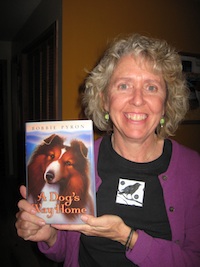
Last Friday I posted a book review for A Dog’s Way Home. This book is the story of a Sheltie’s journey back to his beloved girl. Today, author Bobbie Pyron is here to answer a few questions.
What gave you the inspiration for A Dog’s Way Home?
I like to say A Dog’s Way Home is my personal love letter to my dogs and to all the classic dog books I read growing up, like Lassie Come-Home and The Incredible Journey. It’s a celebration of the two things I have always loved most in the world since I was a child: books and dogs. It was inspired specifically by two of my dogs, my Shetland Sheepdog, Teddy, and my coyote mix, Boo. I started thinking about the story one day when I was hiking with the two of them way up in the mountains. I watched how differently they interacted with their environment and with me-—Boo always off-trail where I can’t see her, hunting, and Teddy never farther than six feet from me. I asked myself, “What if they had to survive on their own in the wilderness?” I knew Boo would be okay, at least physically. But Teddy was another story. So A Dog’s Way Home is his story!
Tell us a little bit about Shelties. What are some of their characteristics? What makes them unique?
Shelties were originally bred as herding dogs on the wild and cold Shetland Islands off the northern end of Scotland. They herded sheep mostly, and they also served as sentry dogs, alerting the crofters when a stranger came on their land. They’re a tough little breed. They are also extremely loyal and very smart. They bond strongly to their people but can be aloof with strangers. They also, generally speaking, are great family dogs. They’re not for everybody, though: they shed a lot and they bark a lot!
I can certainly relate to the shedding and barking! My Sheltie, Lady, seems to have missed the part about being aloof with strangers, though. 🙂
How long did “A Dog’s Way Home” take you to write?
It took about nine months to write the first draft. I tend to edit as I go along. Plus, I still work a day job (I’m a librarian in my “other life”). That first draft was followed by quite a number of revisions and rejections. From first draft to publication in March of 2011, it took about three years. Being an author is not for the faint of heart, nor for the impatient.
 Tell us about your next book, “The Dogs of Winter”.
The Dogs of Winter is based on the true story of Ivan Mishukov, a very young homeless child in Russia. The book takes place in Moscow in the mid-1990s, after the fall of the Soviet Union. Although we tend to think of the Soviet Union’s fall as a good thing, it was devastating to the people of Russia. As a result, there were tens of thousands of homeless children and teens living and doing their best to survive on the streets of Moscow and St. Petersburg. Unlike most of the homeless kids, Ivan did not join one of the many gangs of children living in the underground railway stations. Instead, he was adopted by a pack of feral street dogs and lived with them for two years. My book is a fictionalized account of those two years. My editor, Arthur A. Levine, says it’s a mash-up of Oliver Twist and Julie of the Wolves. But it’s also an exploration of what makes us human and what defines “family.” It’ll be published by Scholastic October 1st.
Thank you for your time, Bobbie!
 Leah E. Good