Guest Book Review: The Princess and the Goblin

Princess and the Goblin, TheOur guest book reviewer today is Emily Ruth. Born 6th of a family of eight, Emily Ruth has been all the way through homeschooling; from birth to graduation. In 2012, she graduated from Grand Canyon University and received her teaching credentials. At this time, she is now acting as a guest teacher in her hometown public school system. From the time she learned to read, Emily has been gorging herself with literature. Some of her very favorite books growing up were “A Little Princess”, “The Crimson Fairy Book”, “The Green Fairy Book”, “The Scarlet Pimpernel”, and all the Austen books she could get her hands on. Enjoy her delightful review of The Princess and the Goblin.
———–
If a little girl told me she had visited her great-great grandmother in the attic, I wouldn’t have believed her either. Such is the life of the little Princess Irene who lives in a huge mansion on a mountain with her nurse and other such occupants to attend her. For all the eight years of her life, Irene has lived unaware and blissfully ignorant of the existence of the Goblins, a fae race that lives under the mountains. They had lived on the surface, but were banished underground, and due to this, kept a burning hatred for not only humans, but especially the royal line. One rainy afternoon, as Irene is exploring the corridors of the mansion, she gets lost, and discovers a hidden occupant of the attics who introduces herself as Queen Irene, Irene’s great-great grandmother. Soon afterwards, Princess Irene and her nurse, who were out for a walk, are saved from a group of Goblins by a brave peasant boy, Curdie. Irene, now aware of the danger around her, soon starts to show her true noble colors. She is aided by Curdie, who discovers a plot against the kingdom and against the princess’s freedom by the goblins.

Frontpiece of The Princess and the GoblinThis tale is great fun, and there is much entertainment in reading it. The plot is somewhat convoluted, and not as simple as children’s books usually are, even for that day’s standards. The character development, however, is incredibly charming to read. Irene goes from a frightened little girl to a brave princess, and Curdie, who is already quite brave, must learn that things are not always what they seem, and to trust the trustworthy.

This book was written a very long time ago, before children’s books started to include “fantasy” as a genre. At this time, the only fantasies you could get was either in adult novels or stories, such as the fairy tale books that Andrew Lang compiled (another review for another time), or the Arthurian Legends. When George MacDonald came out with his “the Princess and the Goblin”, he was providing the world with the natural next step in children’s literature; and single-handedly reshaped modern children’s literature. C.S. Lewis and J.R.R. Tolkien read George MacDonald’s books, and the Chronicles of Narnia and the Hobbit were both influenced by his writings. Thus, however indirectly, many of the fantasy books you read today are influenced by “the Princess and the Goblin”.

Is there a book or an author that you look up to the most for having inspired you towards something you love?
Read it Free on Kindle

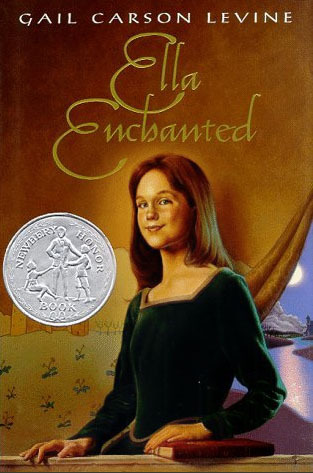
Book Review: Ella Enchanted

Ella Enchanted

Char’s anger at his tutor would be nothing compared with this. He would hate me until the end of the world.

Given the “gift” of obedience at birth by a foolish fairy, Ella has no choice but to obey every command given her. Even a command to harm herself would have to be followed. Ella lives a happy life despite the curse until her mother dies. Her father, who cares only for money, sends her off to finishing school. Ela is miserable as her natural clumsiness clashes with her need to obey. When a ill-humored classmate discovers her secret and uses it against her, Ella flees. But as long as the curse remains, she cannot outrun the danger. What will happen when the prince Ella has come to love and perhaps the entire kingdom hang in the balance?

I don’t read very many fairy tale retellings, but I seem to have a pattern for the ones I do read. For both this story and Beauty, I didn’t care much for the first half but really enjoyed the second half. In this book, I felt the author was trying too hard to establish a fantasy world. The fantasy creatures seemed tacked on. The second half, where the story became recognizable as Cinderella was where I was drawn in and began to really care what happened. My main caution is that the “curse” of obedience does shed a slightly negative light on obedience in general. It worked well for the story, but is definitely something that should not be taken lightly.

What do you consider the pros and cons of this story? How do you feel about a positive ideal like obedience being turned, in a logical way, into a curse?

A Little Princess

Little Princess, A

“Left just one for herself,” she said in a low voice. “And she could have eaten the whole six–I saw it in her eyes.”

Little Sara Crewe lives a charmed life (figuratively, not literally ;)). Though she is devastated by the separation from her beloved father, there is little else she could want as she begins life in Miss Minchin’s boarding school. A few students, and even Miss Minchin herself, develop a distaste for Sara’s quaint ways and ridiculous wealth, but Sara makes friends of most. She captivates the school with her imaginative stories and consistent politeness. As she says when one of her most treasured games is revealed, ” I pretend I am a princess, so that I can try and behave like one.” Her courage is put to the test when she receives word that her father is dead and his fortune gone, wasted on an investment in diamond mines. Sara is turned into a maid and ill treated. Can she behave like a princess even when she is hungry and in rags?

I can’t remember when this story first captured my heart. In fact, I can’t remember a time I didn’t love A Little Princess. After countless readings over the year, I still haven’t tired of it. The luxurious extravagance lavished on Sara by her father during the first part of the book always fascinated me and engaged my imagination, while Sara’s humility and friendliness make her a lovable person to read about. When she loses is everything, her determined courage strengthens the desire to see her happy once again. And who doesn’t like a rags to riches story, especially one enacted in such a unique way?

While I love A Little Princess, I’ve never been able to get through reading The Secret Garden. Which story do you prefer?

Book Review: The Light Princess

Light Princess, The

One day [the prince] lost sight of his retinue in a great forest. These forests are very useful in delivering princes from their courtiers, like a sieve that keeps back the bran. Then the princes get away to follow their fortunes.

When the king and queen of a far off country try to keep a wicked relative from their baby girl, the woman curses the child with the loss of gravity. And so it is that the princess grows up without her gravity, both literally and figuratively. Her nurses must be careful not to let her float up to the ceiling. In addition to floating her way through life, the princess can take nothing seriously. She laughs at even the most serious of matters and causes her parents a great deal of concern. The only time she regains her physical gravity is when she swims. It is in the lake that she meets the prince. The prince who will willingly sacrifice… well, telling you that would give away the end of the book, wouldn’t it? And the ending was by far the best part.

I read this book last year after enjoying Sir Gibbie. (Yes, if you follow the link, it’s the abridged version. No rotten tomato hurling please, that’s the version I read because I got it at a book sale. I didn’t even realize it was abridged at first.) Anyway, The Light Princess was the only other George MacDonald book I could find at the library. So I checked it out. I found myself quickly irritated with the princess. I wanted to slap some sense into her head. But something kept me reading, and when I started tearing up during the prince’s sacrifice at the end, I was glad I’d stuck to it. It’s only a little over 100 pages after all.

Any George MacDonald fans out there? What are your favorite books by this author?

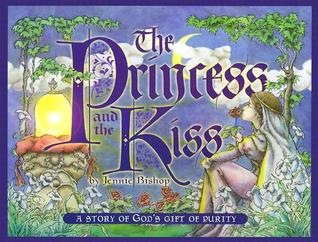
Book Review: The Princess and the Kiss

Princess and the Kiss, TheAs part of my request for theme suggestions last week, lesmiserables1 suggested a princess theme. I’ve received several other great suggestions, but this was the one I could best run with right away. I still need to read at least one more princess story for the month. So, my question for you. What are your favorite princess stories?

Once upon a time there lived a beautiful princess with a precious treasure…her first kiss. As suitors begin to call, the princess searches for a man who will appreciate her kiss, but all seem too caught up in themselves. Until a poor young farmer comes to the castle and offers her his own first kiss.

Yes, it’s a picture book. No, I don’t usually review picture books. Yes, I realize most of my readers are teenagers (though there are plenty of adults hiding in the woodwork!). This picture book is truly timeless. My Dad and I still occasionally pull it out for him to read to me. (Yes, I’m eighteen.) I think Dad got it for me when I was ten or eleven. The first time he read it to me was the first time I made a conscious decision that I wanted to save my first kiss for the man I marry. I’m so grateful to have had this book’s positive influence and to have the foundation of wanting to save my kiss from such a young age. So, yes, I really do recommend this book for anyone. Parents, parents to be, teens, teens younger siblings, you name it. Anyone else saving their first kiss? 🙂

Book Review: The Light in the Forest

Light in the Forest, The
Kidnapped as a child and adopted into an Indian family, True Son thinks of himself as an Indian. He knows with certainty that he no longer has a place in the white men’s world. But when his tribe signs a treaty with the white men, True Son has no option but to return to the white family he feels no connection to. He becomes John Butler again and struggles to relearn the strange language and practices of his family. But perhaps there is no place of belonging for a white Indian.

It has been years since I read this book, but I vividly remember my frustration with the ending of the book. In fact, it remains in my top five least favorite endings. Perhaps now that I’m older I might be able to appreciate it more if I re-read it. I also remember being captivated by the rest of the story. I felt bad for John and wanted to see him adjust and fit into his family. The ending just left me stunned. Perhaps the fact that I still remember it after all this time means the author accomplished his purpose with the story. I don’t know. If you want to find out for yourself, you’ll just have to read it.

Author: Conrad Richter
Genre: Historical Fiction
Pages: 192

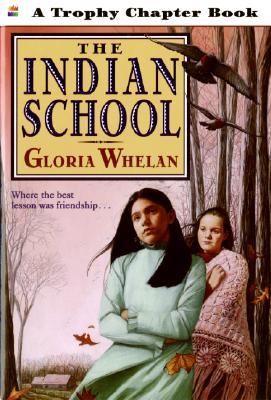
Book Review: Indian School

Indian School

Bring only sensible clothes. Your mother, God rest her soul, was not a practical woman. It may be that you have fripperies in your wardrobe. Do not bring them. Our life here is a simple one.

The Indian School tells the story of Lucy, a young orphan who goes to live with her aunt and uncle who run a school for Indian children. When two new Indian children arrive, Lucy forges a tentative friendship with tough Raven, and even her stern aunt becomes fond of Raven’s little brother, Star Face. When the little boy becomes gravely ill, Aunt Emma and Raven learn to work together to nurse him back to health.

Pros: After recently visiting an Indian mission in Missouri, I enjoyed this fictional taste of what that life was like. As usual, Gloria Whelan’s writing feels authentic and well researched. Definitely a great book for supplementing history lessons.

Cons: While it is not portrayed in a positive light, Lucy’s aunt acts in a condescending manner to her husband. This rubbed me the wrong way at first, but it does sort out in the end to show her aunt beginning to change. Also, Lucy’s growing sense of self-sufficiency and independence sometimes carries a slightly rebellious flavor.

Author: Gloria Whelan
Audience: 6–12 year old
Genre: Historical Fiction
Pages: 89

P.S. My internet connection may not be functional on Monday so the Guess a Quote this week might be late.

Book Review: The Sign of the Beaver

Sign of the Beaver, The

“Six weeks,” his father had said that morning. “Maybe seven. Hard to reckon exactly.”

Six weeks, maybe seven. That is the length of time thirteen-year-old Matt must hold down his family’s claim on his own. Alone in the Maine wilderness, it doesn’t take Matt long to run into trouble. A bear breaks into the cabin and destroys much of his food supply, and Matt is attacked by a swarm of bees when he attempts to get honey from their hive. Saknis, an Indian, nurses him back to health and makes a treaty with Matt. Saknis’s grandson, Attean, will hunt for Matt if Matt will teach Attean to read. At first, Attean has little but contempt for Matt and his white ways, but over time Matt wins Attean’s respect, and a friendship is forged between the two boys.

I grew up watching Keeping the Promise, a movie based off of The Sign of the Beaver. I didn’t discover the book until I was thirteen, and I was delighted to find it much different and even better than the movie. Skimming through it again to write this review reminded me just how much I enjoyed it. It’s also unique in that most pioneer stories are set out west, while this book explores an eastern frontier. Another book that works well both as a fun read and as a history curriculum supplement.

Author: Elizabeth George Speare
Audience: Middle Grade–Tween
Genre: Historical Fiction
Pages: 135